
Bayesian thinking breaks operational paralysis when safety and uncertainty collide
Why do police spend hours searching every room of a school for the remote possibility of a second threat when decades of real-world responses show this is extremely unlikely?

Nothing bothers me more than finding out a wounded student or teacher died from a treatable gunshot wound because rigid procedures teach police to walk past bleeding victims while EMS crews wait a 1/4 mile away in a “cold zone” staging area. We lost the plot when saving lives became a second or third tier response priority.
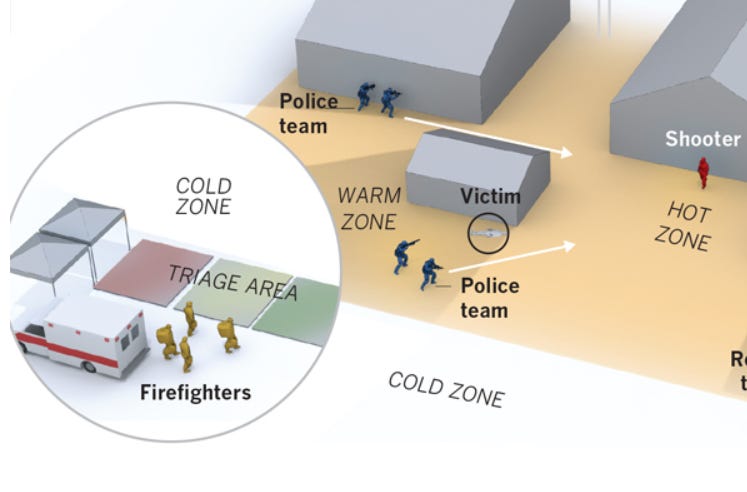
For the last three years, I’ve been writing about the need for a paradigm shift to prioritize life saving care for wounded victims. I’m passionate about this topic because innocent victims’ lives that are lost because of poorly designed policy decisions. The response at Brown University reaffirmed the need for this change:
Based on new documents, it took police 2 hours and 16 minutes to locate all of the wounded victims at Brown University (first shots at 4:06 pm, last victim found at 6:22 pm) while officers focused on “clearing” rooms on campus in search of a shooter who fled before they arrived.
This is why the paradigm needs to shift to make mass shootings and school shootings a fire/EMS response that is supported by police. Over the last 70 years of school shootings, there has never been a second shooter hiding inside a closet waiting to surprise attack police. This is a fantasy that exists to make active shooter training sessions interesting for officers because spending hours searching empty buildings would seem pointless.
When training doesn’t match reality, there are bad outcomes. Treatable victims die during school shooting responses because police are busy searching for a shooter who is dead, fled, or subdued before they arrive.
A better response plan is very simple. If shots are being fired, police need to find the shooter. If no shots are being fired, fire/EMS need to command the incident like a traditional mass casualty with trauma patient transport being the highest priority. Police can secure the crime scene once EMS finishes treating and transporting victims. Just like normal EMS responses every day, if providers are treating a patient and someone starts shooting, you take cover until police arrive and/or the shooting stops.
The average city or suburban fire chief commands multiple MCIs, large building fires, and multi-agency responses every year. It’s rare for a police chief to ever be an incident commander of a short duration, highly complex incident during their entire career. This is why we need to recognize that mass shootings are responses that need bandages and ambulances more than SWAT gear, hot/warm/cold zones, and diamond formations.
Let’s make some progress in 2026 because change is long overdue!
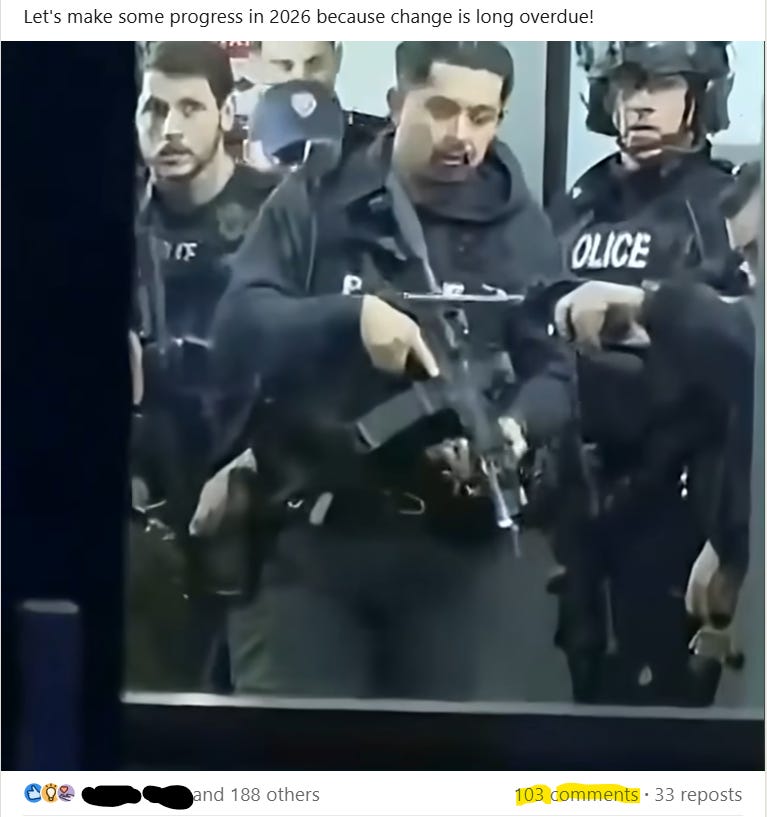
What I didn’t expect after posting this on social media was dozens of comments saying that EMS can’t enter the school until we know with absolute certainty that there is no further threat. As I thought more about why the post-Columbine status quo approach is so deeply engrained, I realized the root cause. Operational level police officers and their frontline supervisors are taught to rely on binary thinking. There is either a threat or no threat, there’s no option in the middle.
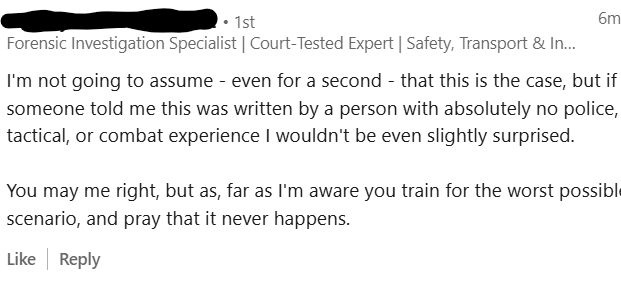
I wasn’t the only person to notice this binary way of thinking:
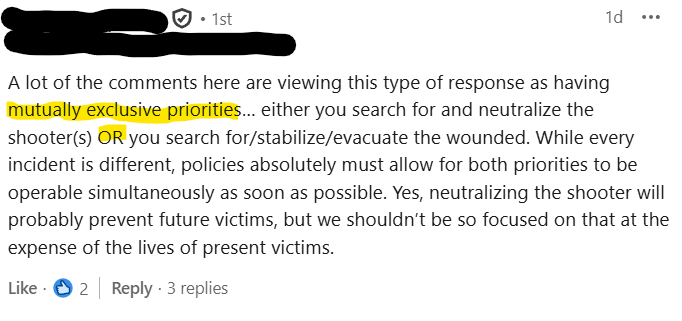
Kids who could be saved are dying inside their schools because the real world isn’t binary when multiple correct and necessary decisions/actions must occur simultaneously. Threats aren’t simply “real” or “fake,” eliminating risks aren’t the absolutes of “cleared” or “not cleared,” and safety isn’t a switch we flip from unsafe to zero risk. Police have been training with only black and white options like:
“Every school shooting threat must be taken absolutely seriously.”
“Police must search every room to be 100% sure there’s no second shooter.”
“EMS can’t enter until there’s zero possible danger.”
This isn’t just bureaucracy, it’s binary thinking that prevents nuance, wastes resources, and often reduces safety instead of increasing it. In complex situations with many unknowns, Bayesian statistics offer a much better model for reasoning about threats, risk, evidence, and actions.
Binary Thinking Is Intuitive Even When It’s Wrong
The absolutist rhetoric in the comments on my social media post come from a place of fear but they reflect categorical cognitive rigidity: if threat X is reported, maximal response equals safety. For binary thinkers, that’s the end of the story because that’s a mindset that says uncertainty means doing nothing until every unknown goes away.
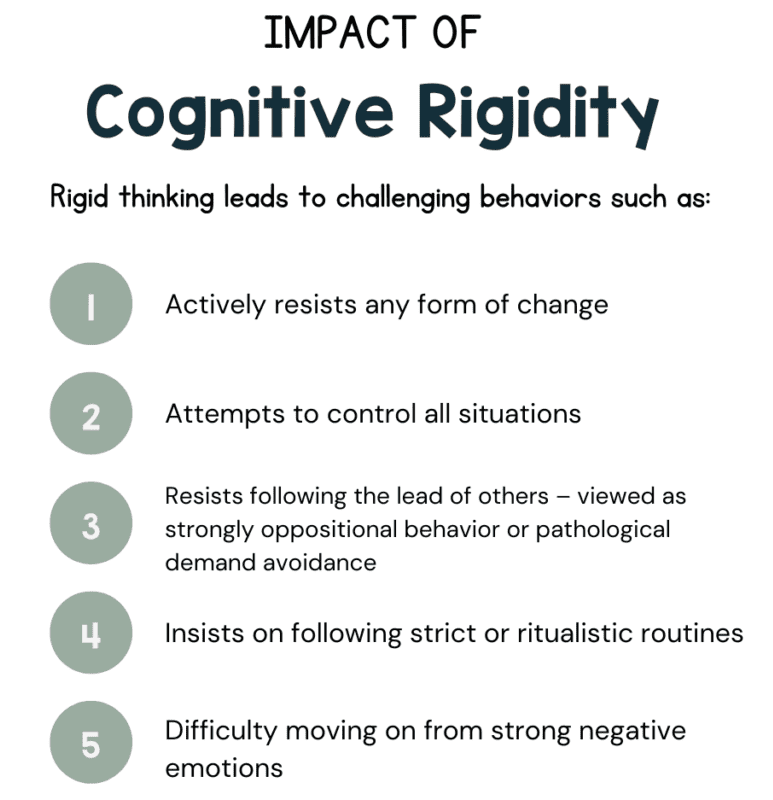
A better approach is to quantify uncertainty and acting on it. That’s the core of Bayesian statistics which is a formalized way of thinking about probability as degrees of belief instead of simple yes/no or safe/danger labels.
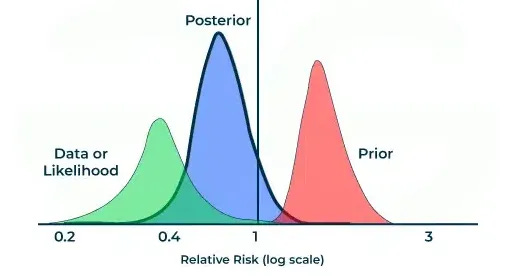
Here’s the intuitive backbone:
Prior probability – what you believe before seeing new data.
Evidence/Likelihood – the new information you observe.
Posterior probability – what you believe after seeing the evidence.
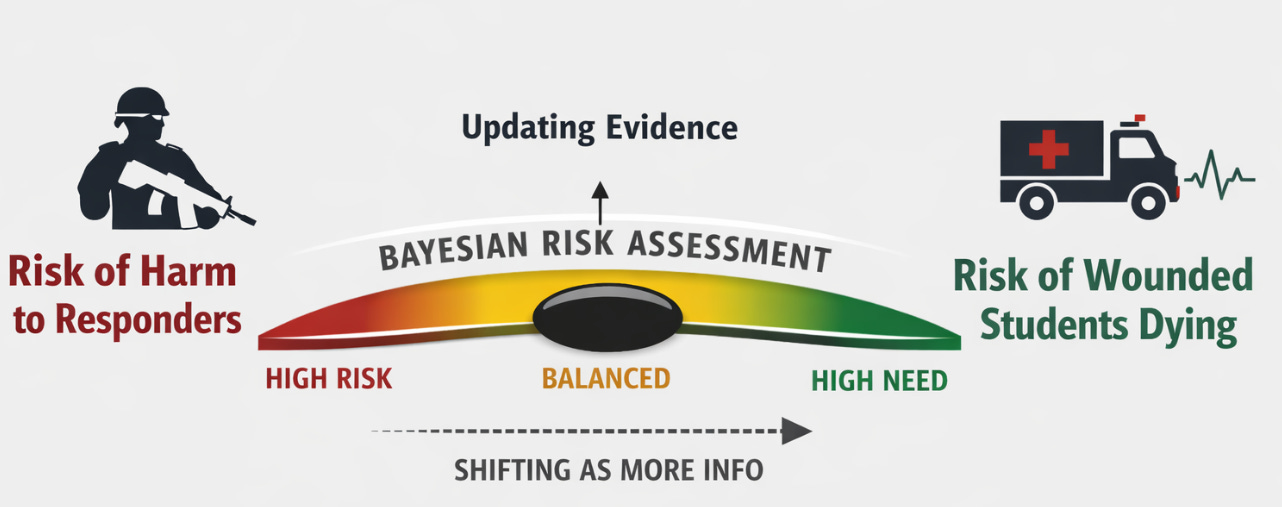
Bayes’ theorem gives you a mathematical recipe to update a prior belief in light of new evidence so that your posterior belief reflects both the initial uncertainty and what you’ve just learned. Using Bayesian reasoning in a school shooting response, each minute without additional gunfire updates the prior probability of an active ongoing threat. More time without bullets fired shifts the risk–benefit calculation toward EMS entry as the expected harm to victims from delayed medical care outweigh the diminishing likelihood of discovering an assailant who poses continued danger.
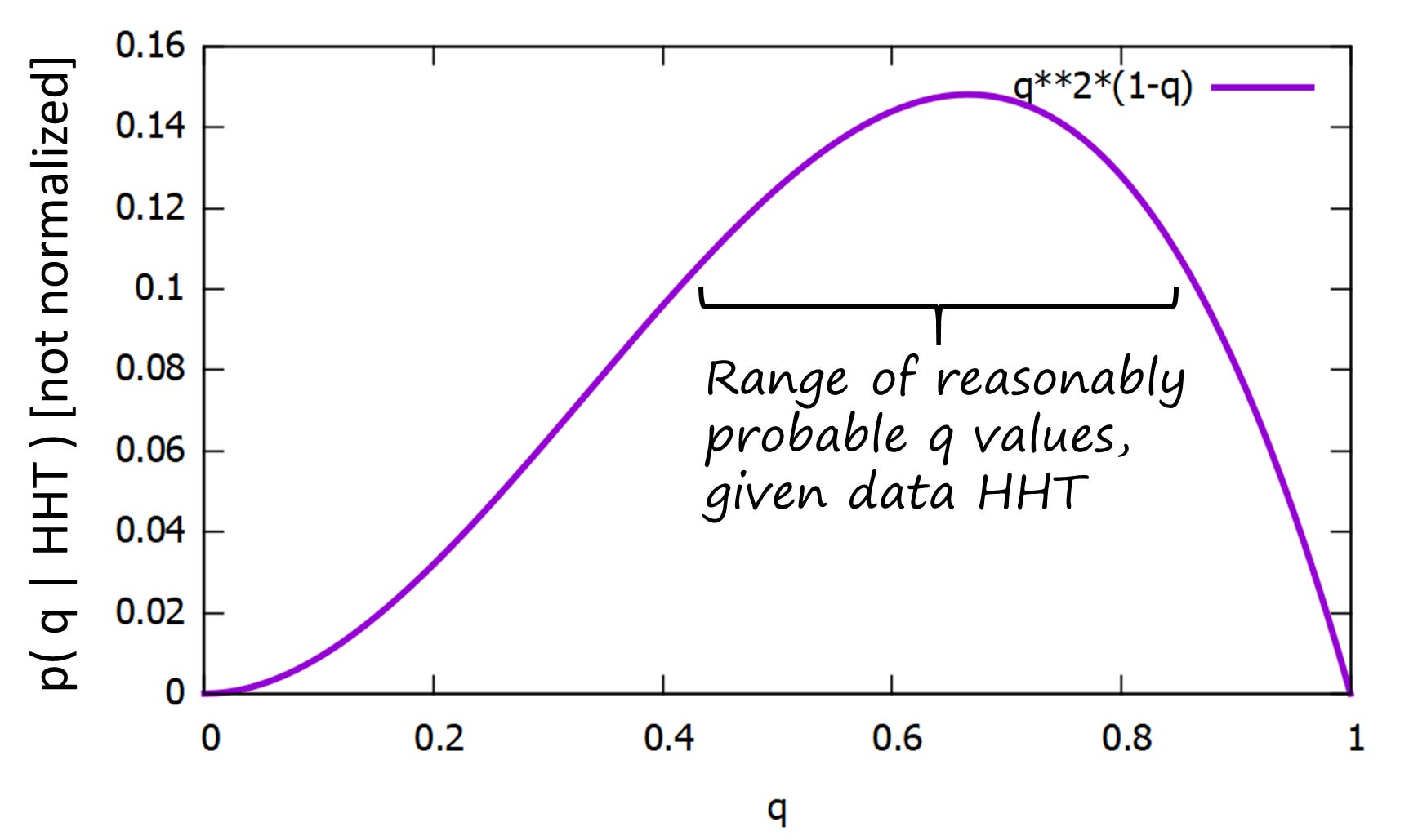
Mathematically it’s written as:
Posterior = (Likelihood × Prior) / Evidence
It’s fine if this equation doesn’t make complete sense because what matters is the idea that beliefs are always provisional and updateable.
This way of thinking with probabilities applies to more than just the danger/safety during a school shooting response. Imagine you’re trying to judge if an ambiguous threat posted on social media is real (the topic of my PhD dissertation). You start with a prior belief based on base rates, context, and history that most social media threats aren’t actually imminent attack plots. Then you add evidence from the credibility of the profile, information about the person who made the post, likelihood of access to weapons, timing, proximity to the school, and so on.
Each piece of new information increases or decreases your confidence proportionally, not absolutely. That’s Bayesian thinking in action.
Binary thinking fails us
Humans are notoriously bad at conceptualizing base rates which are how common something actually is. For example with disease testing, a test that’s 99% accurate doesn’t mean a positive result is 99% likely to indicate disease. This is because if the disease is rare (1 occurrence in 1 million people), most positives will be false (1 million tests will yield 10,000 positives when only 1 person actually has the disease). Bayes’ theorem tells us how to account for both the accuracy and the underlying rarity.

Similarly, thousands of school shooting threats are made every year, but a very small percentage correspond to actual violence. Treating each threat as a binary (real threat vs. not a threat) causes a huge police response and investigation for a very low probability of real risk.
Without acknowledging the prior probability, our responses look impressive but aren’t efficiently aligned with actual risk. A rule like “search every room before anything else” sounds thorough, but it also:
Delays medical care for critical victims.
Delays evacuation.
Increases psychological trauma to students during extended lockdowns.
Increases the chance of an officer accidentally firing their gun during a search.
If you act as if the existence of a possible second shooter is an on/off variable, you miss the opportunity to triage effectively. Bayesian thinking lets you gauge how likely a second shooter is given the totality of evidence, not just the possibility of one.
The idea that EMS should not enter until “zero risk” comes from fear of uncertainty, not judgment under uncertainty. In reality, uncertainty is never zero but that doesn’t mean it’s high enough to justify inaction. See more in my prior article: Wounded victims can die when plans are based on the ‘second shooter’ fallacy
Bayesian thinking doesn’t ignore false alarms or remote possibilities of additional threats because it weights them. As evidence accumulates (e.g., 10 minutes has passed since the last gunshot was fired), it becomes clearer which situations are high-risk and which are not.
Bayesian Thinking in the Real World
Bayesian reasoning isn’t some ivory-tower academic thought exercise. Imagine three escalating scenarios that a school faces:
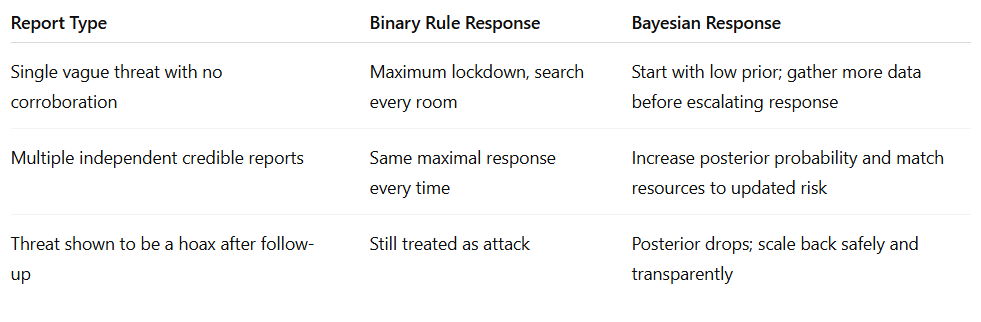
From the table, the biggest difference between binary and Bayesian thinking scales your response to the evidence you actually have, not to the anxiety you feel about uncertainty.
Those social media commenters who insisted on absolutist approaches weren’t doing nuanced reasoning because they were protecting themselves from discomfort and relying on rigid thinking to counter the complexity of uncertainty. It’s the mind’s natural bias to say “do everything” rather than to say “let’s think this through.” But when the stakes are children’s lives, thinking with probabilities to balance risks while maximizing reward matters.
During the chaos of hundreds of police, firefighters, and paramedics rushing to the scene of a mass shooting, we need to teach emergency responders to embrace uncertainty because we will never have perfect information about every possible threat. Bayesian thinking doesn’t make uncertainty go away, instead it gives us a framework to act with uncertainty—not against it—in complex situations.
David Riedman, PhD is the creator of the K-12 School Shooting Database, Chief Data Officer at a global risk management firm, and a tenure-track professor. Listen to my podcast—Riedman Report: Risk, AI, Education & Security—or my recent interviews on Freakonomics Radio and the New England Journal of Medicine.
Excellent commentary.