
Is using AI cheating or is it hacking?
Hacking is manipulating or exploiting a system to perform actions or access information that was not originally intended by its creators.

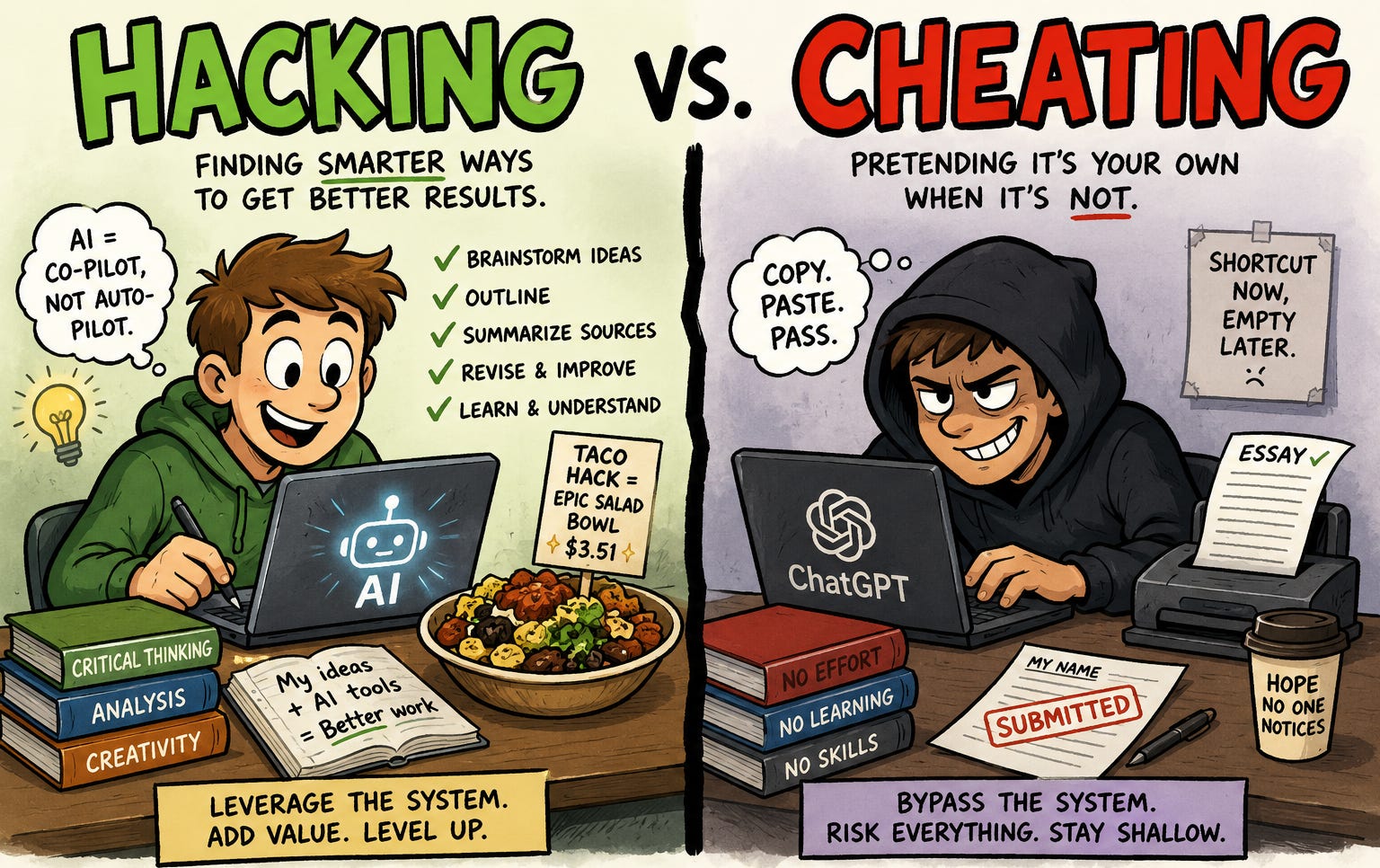
Hacking tends to be used as a negative term but most hacking isn’t illegal. Think about all the viral ‘hack’ posts on algorithmic (social) media. Hacking is getting a giant fresh salad bowl for only $3.51 from Whole Foods by ordering one taco (then adding a bunch of free toppings like tofu, potato, black beans, rice, vegan chorizo, pico, and onions). This isn’t illegal. Hacking is just an action that benefits the hacker and wasn’t intended by the creator.

I’ve written a bunch of articles recently that are hypercritical of AI and LLMs because I feel like they are having a very negative impact on higher education. But I can also look this problem from the flipside. When it’s pretty much impossible to punish students for using ChatGPT when the AI-generated work meets the grading requirements of an assignment. So maybe students aren’t cheating…they are hacking the education system.
On the latest episode of Decoder, Recording Academy CEO Harvey Mason Jr (who also manages the Grammy Awards) discussed AI and the music industry. He explained that song writers and artists are using AI to:
Compose the backup instruments to support the main track
Sing the backup vocals or harmonies
Write a second verse based on the artist’s first verse
Create a draft of a song based on a title or theme
Make a demo in an artist’s voice to pitch a new song to them
If a musician who doesn’t have a big recording contract and budget can use AI instead of paying backup singers/musicians, mix the track with AI instead of paying an engineer, and produce music video clips for TikTok instead of paying a production company…is that artist cheating or just hacking the music industry?
This question matters because right now society tends to celebrate hacking everywhere except education. Businesses reward employees for finding shortcuts and using technology to increase productivity. Very few people (other than the partners of a law firm) are upset when a lawyer uses AI to summarize documents in minutes instead of charging you 6 hours of labor at $500/hr. Big Tech CEOs are forcing engineers to use AI copilots to help write code faster, yet AI code isn’t labeled as plagiarism.
But when students do essentially the same thing (and I’m guilty of this), the reaction suddenly changes from innovation to defending academic integrity. Maybe it’s the fault of universities and educators that we haven’t moved fast enough to patch the exploits that student hackers found so easily. Most assignments are designed around the assumption that students will individually produce work from scratch and the effort that goes into that writing is the learning process. The exploit savvy student hackers found is that generative AI eliminates the time, effort, and most of the learning.
This exploit in the education system is a huge attack surface for a hacker because most assignments are easy for AI to complete because they were already formulaic. A generic five-paragraph essay about symbolism in The Great Gatsby isn’t intended to push a student to a new literary discovery, it’s a predictable template exercise. ChatGPT simply exposed how repetitive and automatable most assignments have become.
Is hacking learning?
A student blindly submitting AI outputs is cheating themselves out of the learning process, but they might not be cheating academically if they meet the requirements of an assignment. While some of my students post straight from ChatGPT, others use it to help them think and that’s going to be the future. An AI chatbot can be an $20/month assistant who can outline, brainstorm, review work, poke holes in arguments, and proofread instead of a being a one prompt replacement for thinking.
If students graduate without the ability to analyze, write, reason, or communicate independently, the long-term consequences are going to be severe. Schools also must confront reality that the education system is probably not going to win an enforcement war against ChatGPT. Detection software already struggles to reliably identify AI-generated writing and the models are improving faster than formal institutional policies can adapt. Students also know the “adult world” already embraces these tools so it’s in their best interest to be the best AI users on the job market. When the biggest companies in the world are openly encourage (or outright forcing) AI integration, why should professors ban it from the classroom?
Regardless of your position on AI versus human work, we do a have a huge legitimacy problem either way. Formal systems lose authority when their rules no longer match reality. If a student fails an essay because an AI detector said it had a high probability of being LLM-generated text, is this arbitrary finding disconnected from how the world actually functions? When higher education doesn’t match the skills and rewards of the higher employment market, what’s the point of spending 8 hours versus 8 seconds writing an essay?
The Oxford definition of plagiarism is presenting work or ideas from another source as your own, with or without consent of the original author, by incorporating it into your work without full acknowledgement. A ChatGPT generated essay does not exist anywhere else, and it was created by the actions in the student’s prompt. By definition, it’s not plagiarism.
I’m starting to face the uncomfortable truth that students are not cheating, they are just hacking the education system. They are identifying inefficiencies, exploiting technological advantages, and maximizing output with minimal inputs. If these students were running a startup, society would call this innovation.
When travel hackers figured out that booking an extra leg on an airline ticket could get a lower fare, complaining about the exploit didn’t help the airlines. Instead they had to come up with novel approaches to punish passengers who booked a two-leg flight and didn’t get on the second plane. It turns out that the savvy travelers who have the skills to find the lowest fares, also like the airline rewards programs. So when travels get caught skiplagging, the airlines started cancelling their premium status.

Skiplagging was a problem the airlines had to figure out because the exploit went viral. If instead of using a Skiplag website, you asked ChatGPT to find the lowest price for your trip, is that cheating or just hacking the system? This is exactly why students share LLM prompts the same way travelers share hidden-city routes. There is an entire TikTok ecosystem around “academic hacks” using AI but just like hidden city airfare, they really work.
Instead of complaining about legacy software that has been exploited and has a huge seemingly unfixable vulnerability, educators need to rethink our approach to higher education. Discussion boards with 2 peer responses and 1,000 word essays are the most common assignments because they are the easiest ones for professors to create, update, and grade. When short vertical videos with someone talking at their phone are the most viral content, maybe having a student record video responses to ten different questions are better than an essay. Giving bonus points for a real-world background that relates to the assignment could make it even more authentic and harder to fake.
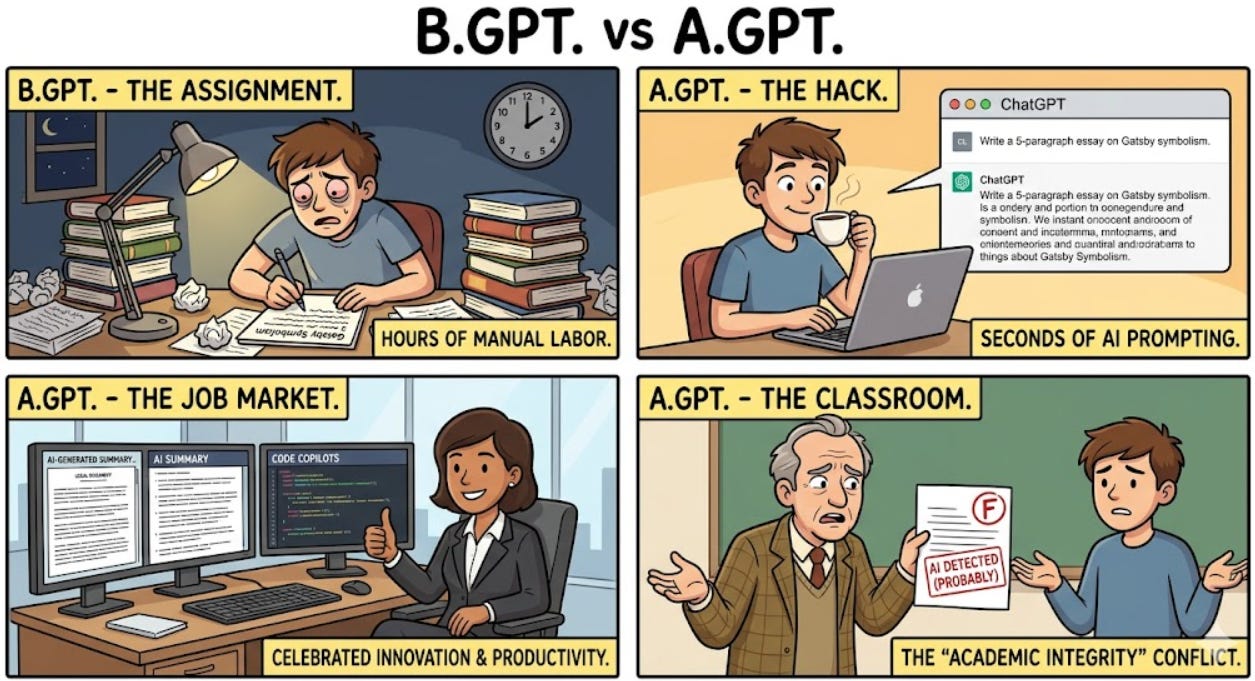
I don’t know what the next few years will look like in higher education, but I do know that just like measuring time based on Before Christ (B.C.) and Anno Domini (A.D.), there is a B.GPT. (before) and A.GPT. (after) era. Maintaining the B.GPT. status quo in higher education is not going to work in the A.GPT. world.
David Riedman, PhD is the creator of the K-12 School Shooting Database, Chief Data Officer at a global risk management firm, and a tenure-track professor. Listen to my podcast—Riedman Report: Risk, AI, Education & Security—or my interviews on Freakonomics Radio and the New England Journal of Medicine.